
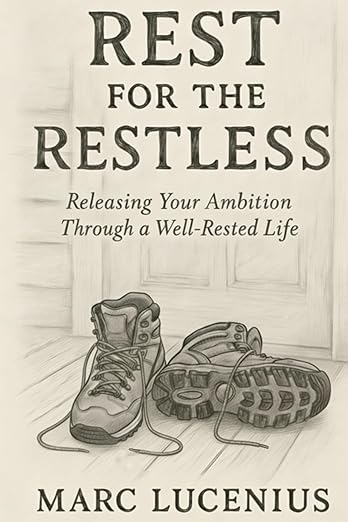
Ambition is often treated as a problem to solve: something to tame, suppress, or outgrow. In many spiritual formation circles, the message can sound like “wanting more” is inherently dangerous for the soul. Meanwhile, leadership and productivity culture frequently pushes in the opposite direction—keep building, keep scaling, keep grinding—while restoration is reduced to a weekend off or a self-care checklist.
Marc Lucenius, an author, speaker, and coach based in Thornton, Pennsylvania, offers a different framework: you can live with holy ambition without burning out. His work centers on a practical, gospel-rooted vision of calling—one that does not require exhaustion as the price of impact.
Reframing ambition: enemy of the soul or evidence of calling?
Lucenius’s approach begins with a reframe. Rather than assuming ambition is either virtuous (because it produces results) or sinful (because it can become self-centered), he asks a more formative question: what if calling is central to how God shapes a person’s inner life?
This matters because ambition is not just a behavior; it’s a force that organizes attention, schedules, relationships, and identity. When ambition is disconnected from spiritual formation, it tends to demand more and more—more output, more validation, more certainty—until a person’s body and soul can’t keep pace.
By contrast, when ambition is integrated with the historic gospel—simple, freeing, and deeply clarifying—it can become a channel for faithful service rather than a treadmill of performance.
The gospel at the center: simple, freeing, and sustainable
Lucenius emphasizes that the gospel is not merely an entry point into faith; it is the ongoing center of everything he does. That conviction shapes how he writes, speaks, and coaches people who feel pulled between big dreams and real limits.
In practice, a gospel-centered approach to ambition tends to produce three stabilizing outcomes:
- Identity before output: your worth isn’t negotiated through productivity.
- Calling with constraints: limits aren’t failures; they are part of faithful stewardship.
- Rest as formation: restoration is not an afterthought—it’s a means of becoming the kind of person who can endure.
That combination helps ambitious people pursue meaningful work without treating exhaustion as a badge of honor.
Where ministry meets modern pressure: change, fear, and instability
Ministries today face familiar challenges in new forms: rapid cultural change, anxious hearts, and economic instability. The pace of information and the intensity of social comparison can amplify insecurity, making leaders feel as if they must respond to everything immediately—or risk losing relevance.
Lucenius’s stated marketing challenge—allocating focus to what God has called him to—captures a widespread leadership tension. Many leaders don’t lack opportunities; they lack clarity and permission to concentrate. In a world that rewards constant visibility, focus becomes a spiritual discipline.
Balancing tradition and innovation without losing the thread
One of the most practical questions for churches and faith-based leaders is how to remain rooted while communicating with creativity. Lucenius describes his approach in two movements: preach the historic gospel without apology, and then find as many compelling ways to say it as possible.
That balance serves two audiences at once:
- Those seeking stability, transcendence, and continuity—often drawn to tradition.
- Those who have lost hope—often reached through fresh language, stories, and new points of connection.
In other words, innovation is not about novelty for its own sake; it’s about communicating enduring truth in a way people can actually receive.
Recovery and resilience: building long-term pathways for healing
Lucenius’s community engagement includes a long-standing commitment to recovery ministry. Nearly two decades ago, he helped build a Celebrate Recovery program that continues to serve people today. He also describes embedding “recovery DNA” into his current church context through a ministry focused on working through the steps known as Re:Generation Recovery.
This emphasis matters for burnout conversations because exhaustion is not only a leadership issue; it is often connected to deeper patterns—shame, isolation, coping mechanisms, and unresolved pain. Communities that normalize confession, support, and practical steps toward freedom create the conditions for sustainable ambition.
Technology, attention, and the discipline of restraint
Most leaders feel pressure to maximize social media and be everywhere at once. Lucenius takes a measured view: technology can help spread a message, but it can also fragment attention and drain energy. Choosing restraint—especially when the online world rewards constant posting—can be a strategic and spiritual decision.
For ambitious leaders, that restraint can look like:
- Defining a clear “yes” before saying “no” to distractions.
- Using technology intentionally rather than reactively.
- Prioritizing depth of impact over breadth of visibility.
Developing younger generations: show up, serve, lead
When asked how younger generations can be more involved in ministry, Lucenius points to a straightforward pathway: show up, serve, and use leadership talents to call one another to follow Jesus. That model resists consumer spirituality and instead forms people through responsibility, relationships, and real contribution.
It also aligns with the broader theme of ambition without burnout: meaningful leadership is not built by chasing platforms; it grows through faithful presence over time.
Working with Marc Lucenius: coaching, speaking, and formation
Lucenius describes himself as “a pastor to everyone who wants one,” and his work spans writing, speaking, and coaching for men and women who want to pursue big callings without losing their souls in the process. Readers and leaders interested in his resources can learn more at Marc Lucenius, author.
Key takeaways: pursuing big callings without the crash
- Ambition is not automatically the enemy. The deeper question is what forms it and what it serves.
- Restoration can’t be an afterthought. Sustainable leadership requires rhythms that shape the soul.
- Focus is faithfulness. Not every good opportunity is your calling.
- Tradition and creativity can coexist. Keep the gospel central; vary the ways you communicate it.
- Healing builds resilience. Recovery pathways strengthen communities and leaders alike.
Profiles like this highlight a growing hunger for leadership that is both ambitious and grounded—driven by purpose, anchored in faith, and practiced with endurance rather than exhaustion, as seen on Daily News Network.